Why I built Informed Patient
Cat’s story
I don’t want to replace care with technology. I want us to get better care.
My dad’s reaction was bad.
Very bad.
He’d had some skin reactions after his first round of cancer treatment. This was not unexpected. But now we were looking at a serious escalation.
Within minutes of arriving at the ER, he was admitted to the hospital, and I knew why.
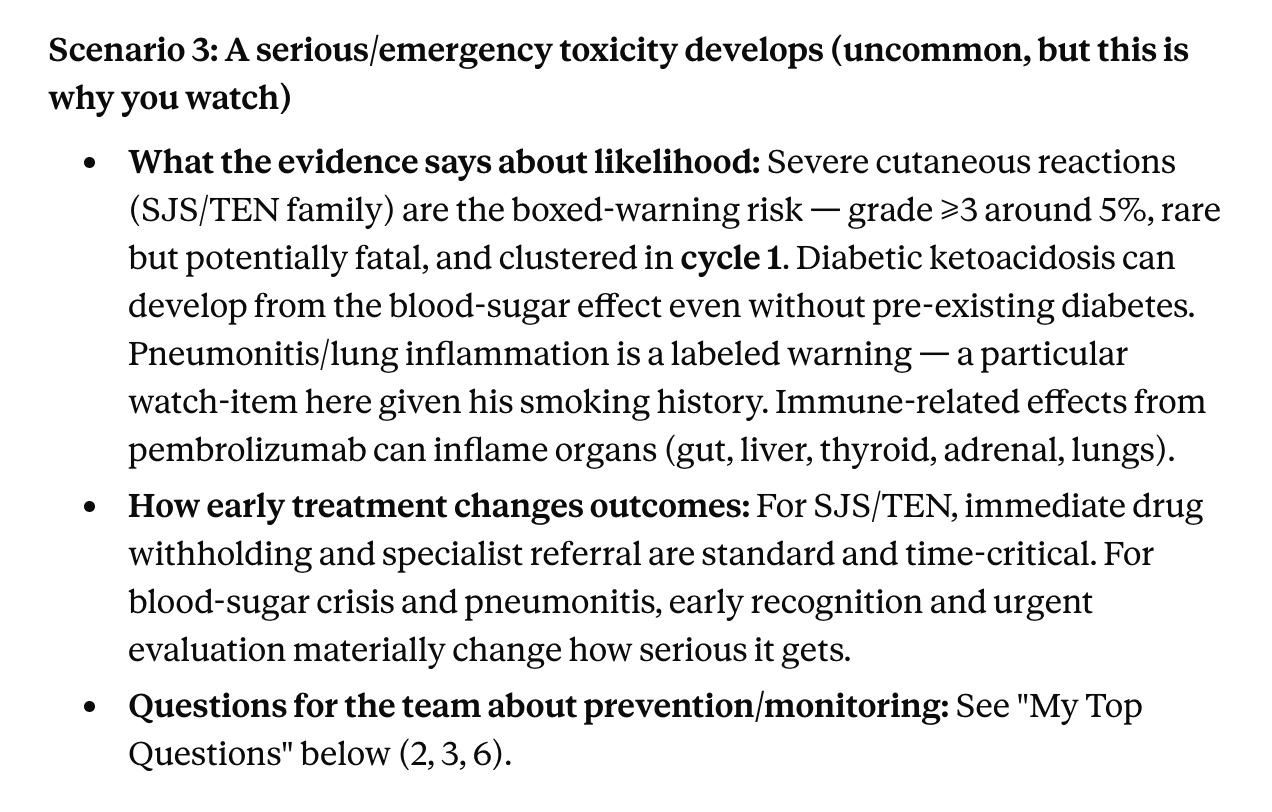
It looked like early SJS/TEN, skin blistering horrifically.
If it’s that, and if it advances, the mortality stats are not reassuring.
Health crises teach you that we are somehow both terrifyingly alone, and in it together. They also teach you that if you can predict things better, sooner, and more accurately, you can claw a better recovery out of the unfeeling stats of the universe.
I think this kind of crisis teaches you about being human. It is us, and our knowledge, against the dark. It is us and whatever we can learn and then share fast enough.
I wanted to help my dad tip the scales however I could. I got on a plane, sent a text, hoped it wouldn’t be the last thing I ever said to my dad.
Then I got to work on my laptop, riding the airplane wifi toward whatever evidence I could gather. My fingers and the tendons along my arms ached horribly, like a slow trickle of gasoline was rolling through the intricate architecture of my elbows. At the same time as my dad's hospitalization I was having a health crisis of my own which was, surreally, a severe adverse reaction to a medication. My particular adverse reaction included widespread, sudden onset, very severe tendinopathy that was making it very difficult for me to type, to walk, to hold a pen, to be a good friend, to fall asleep at night, and to carry luggage through an airport. There was nothing to be done about that; tendons just have to heal very slowly and I’d already taken the medication that hurt me. But my dad was in the mystery, in the space between an event and a conclusion, the space of hypothesis.
My own pain would have to wait.
I opened a folder that I had made a month earlier: a health evidence review of my dad’s bladder cancer treatment plan and its adverse reactions.
I had created it out of several rounds I’d run with Informed Patient, my AI-assisted lit review and evidence analysis tool.
I thought—with the nostalgic pang that can comes alongside feeling very stressed out about your parents—of all the times my dad made fun of how seriously I took my homework every time I was home from college.
Now, homework was about to save him.
A month before that plane, I had already found the evidence he was going to need, and I had no idea. From case reports about my dad’s treatment, scouring clinical trials, endlessly refining the vocabulary for describing his symptoms, I’d made a reference table of the top scenarios we might need to triage, as well as evidence for and against them.
In that table was a case report that perfectly described my dad’s rare reaction. In that case report was a set of pictures from another patient that looked exactly like the pictures from my dad.
Access
I built Informed Patient because I wanted a consistent and repeatable protocol for finding, evaluating and breaking down health evidence.
First for me, then for all the people I knew who were struggling to make sense of their care.
In 2025, I attended a virtual patient conference organized by a patient advocacy group for a condition I’d recently been diagnosed with. Emerging research was scarce, and enormously valuable to this group, but difficult to follow.
Besides being a patient, as an evidence designer and quantitative social scientist, I’ve had a career-long interest in how we define and use evidence. So I started translating the presented outcome measures in the conference zoom chat.
I was flooded with requests asking me to weigh in about research. That started me on a path of sitting with fellow patients on zoom calls and phone calls, talking about their health questions.
These patients were all using AI, constantly.
Here were things I noticed:
- The key risk in using AI for healthcare questions is the model bias for "helpful," affirming responses and to summarize on behalf of users.
- Models frequently encode poor evidence analysis practices, such as over-extrapolating from a single study, or representing findings as "proven" merely by statistical significance without considering other factors: the type of people studied, the quality and depth of data, the accuracy of measurements.
- When users ask AI models about health in basic prompts, this can lead to models generating answers that overstate evidence, or flatten user descriptions of symptoms.
- Taking a structured patient inventory seriously helps deepen the model's search.
- Causality—what leads to what—in health is multivariate, complex, difficult to figure out. Many symptoms can look similar but be caused by different things, and the same condition can even present differently for different individuals.
- People needed a great deal more help growing their literacy about what LLMs are doing, not doing, and what sources and information are being used for that output.
The core idea of Informed Patient sought to break open the black box, use structure to create better search patterns, and design a harness that could help sequence exploration and audit evidence quality.
I believed in the power of using language models to understand what was, to me, fundamentally evidence trapped in the technology of language. I had spent months in patient communities already, after many months of trying to understand what was happening in my own body and why doctors mostly didn’t seem to be interested in helping me with it. I discovered respiratory therapy exercises that helped me significantly after covid hit my lungs hard, documented in the literature but rarely used in practice with the patients who needed it.
Scientific literature is massive, too massive to fully know even for a specialist like me who reads papers every saturday with her coffee (there’s that homework!).
I wanted something that would give me links, and help me map the semantic space around the unfamiliar language of health.
I was already familiar with the enormous impact that could come from this: I had been misdiagnosed myself for multiple months, with progressing symptoms, a situation that I could only resolve once I had figured out how to make an exact match between the language I was using to describe my symptoms and the language medical science used.
So I developed a conviction:
The patient inventory should be a place to both elicit better, more accurate information about complex health, but also a place where patients could learn why doctors aren’t hearing them. Informed Patient became about an iterative interview, assessing symptoms backwards and forwards, not just about a list of references. And for that interview to work, it had to take place in the bounded context of high quality evidence. I used it myself, constantly, and it changed my life.
That patient conference I went to in 2025?
It turned that I had been misdiagnosed. I started questioning the efficacy of the treatment regime I was on in the summer of 2025, and I began to run Informed Patient searches in August.
The very first run surfaced the hypothesis that would end up being the correct one, with “evidence for” and “evidence against” I would need to bring to my providers.
In April of 2026 I went to a specialist who finally listened to me, in June of 2026 I was prescribed a treatment that has a pretty solid chance of changing the rest of my life—this after fighting an insurance denial; Informed Patient independently surfaced the exact same references that my specialist listed in her appeal, a fun moment for me of secret quality control.
There is a “window of opportunity” with the autoimmune condition I have: if you can access a treatment for it within the first eighteen months to two years, you more than double your chances of being in a very good outcome category. As with many statistics you can think about them from the other direction: if you miss the window of opportunity your chances are cut in half.
Hospital
My dad was in the hospital for nearly a week.
People who care for patients in hospitals are doing amazing work. He received good care, and the people giving it were kind. There is a lot of indignity in a hospital but there is a lot of commitment, too.
My dad must have been in a lot of pain but he preferred not to talk about it. Instead my dad, a teacher for his whole career, learned the names of the children of everyone he saw, what they liked, what they were studying, what their hobbies were, what schools they went to.
He was on a horrific amount of medications, his white cell count had crashed, and side effects were piling up.
But he began improving on steroids and that was excellent news. He wasn’t eating, which worried me, and I used Informed Patient again to look up anything I could learn about cancer treatment’s effect on the appetite (a lot), the intersection of medications’ effect on the appetite (a lot), the potential impact of neuropathy from cancer treatment on appetite (a lot). It was all (a lot).
The evidence reviews in hand gave me the mental space to just be there. As a psychologist of environments, I knew something about about gently offering new behaviors to people in a way that can activate our beliefs and motivation to help us try to do hard things. My dad never wanted to eat but I said well I’m hungry, and so we went slowly to the downstairs hospital cafeteria for me, and I baited the hook with the kind of meal I saw my dad eat so many times when I was a kid.
Every day of visiting I clutched a list of questions I’d made on the plane but hadn’t been able to raise with a doctor.
A nurse told me that his reaction was a medication reaction. This was frustratingly vague. However, I knew from the research that which kind of reaction mattered.
It mattered because accurately assessing the reaction could change the potential treatment plan, and that treatment plan mattered when it came to cancer outcomes. But we were missing information that could characterize the reaction, and it was time-sensitive. One suggested piece of evidence from my Informed Patient health review was a biopsy; a dermatologist would be the one to do it.
The hospital had no idea what I meant when I said it, so I saved that question–and all the rest–for the oncology center.
Back at his house, I looked through piles of brochures from the oncology center. They send lists home with patients of reactions to look for, but they were all just vague bullet points with no sense of severity, decision-making, or judgment.
My dad said more than once, wearily, that he had no idea what they thought he was going to do with it. I deliberated for a long while about trying to organize that information. Finally I just taped two phone numbers onto his fridge, the medical offices to call for a triage.
Home & tests
I can’t prove it but I believe strongly that my strategic ability to find Frito’s—my dad’s favorite of the hospital snacks—was responsible for him turning a corner.
He got well enough to come home, although going home opened up a whole new can of worms in the form of many side effects from the new meds he was on.
Now I was running Informed Patient to dig up why he’d come home with so many new prescriptions, whether they interacted, and what we should ask his pharmacy about. He was in a horrendous amount of leg pain, enough that he couldn’t sleep.
One of my Informed Patient reviews suggested asking his oncology center about potassium deficits, and we’d discover, indeed, a potassium deficit.
Steroids make a lot of people angry and difficult to be around.
They made my dad want to listen to classical music and talk about philosophy.
I was exhausted, but it was also kind of lovely. We talked, shared favorite songs, and my dad proudly told his nurses about my book. Even in a hospital your dad can still embarass you. He started asking me many questions about his cancer and its treatment, because after Informed Patient showed me where to look I'd read the clinical trials behind all of it. He also said, bemusedly, “You know more about my treatment than the nurses!”
I don’t know if that’s true, but I do know that medical information and science is vast, splintered, and complicated; that families and caregivers are the ones who have to hold the questions, point out when their loved one is in so much pain they can’t sleep, and make the decision about going back to the hospital or not.
I stood in the frozen aisle of a nice bright clean midwestern grocery store and stared at the chicken for a long time because I was so exhausted I couldn’t figure out what to make.
I drifted in and out of Nebraska cafes with what I am sure was a glassy stare, and people were very kind to me.
At the oncology center, days after the hospital discharge, I clutched my file of case report printouts. I asked my dad’s nurse if ordering a biopsy was warranted, if it would change the treatment plan.
That was what the research said, and it also warned this time-sensitive investigation was frequently missed.
Just a little over a year earlier, I had been given my misdiagnosis in a single appointment, for a condition that typically is diagnosed with a biopsy, after a provider decided not to order a biopsy.
That appointment had lasted twelve minutes, and began a treatment that would negatively affect me for seven months.
I do not think the provider I had was uncaring, or meant for any of that to happen. But do I think the system leaves patients unseen, unheard, unhelped. If you miss a moment when you could get evidence about what’s really happening to you, you can miss your window of opportunity altogether.
This time, in this room, the nurse listened to me, leaving to look into it.
We went to do a potassium infusion, just as I’d expected with the help of Informed Patient. The nurse returned: I was right, we could distinguish between the types of reaction that my dad was having with a biopsy, and this could affect the treatment plan.
They were going to order it.
I’m happy to say that my dad is improving. We got through it, philosophy and all, and it remains one of the hardest yet most meaningful months of my life.
They put him on a new treatment plan. The nurse wrote the names of the medications on a post-it note: "for your daughter, who will want to know."
Likewise, I am healing, every day getting further from the adverse reaction that happened to me.
I’ve used Informed Patient hundreds of times over the past year, to validate that there was evidence behind what was happening to me, to find and pull the clinical endpoints about my dad’s treatment that were more nuanced than the summaries I’d seen, to get a handle on what we could expect, making it into something we could plan for.
The one time I did not use Informed Patient to go deep into the evidence during a health decision?
When I was prescribed the medication that caused my adverse reaction.
I do not know if it would have surfaced this risk, but I do know that the clinical guidelines for the medication I was prescribed warn about it and would have been easily findable.
I know that I have multiple characteristics that are documented risk factors for this adverse reaction. And I know that guidelines from the research state that alternatives should be considered for patients with my characteristics. But guidelines are easy to miss, and clinical practice regularly falls behind the evidence.
When my adverse reaction started, Informed Patient’s inventory protocol asked me about recent medications, and specifically asked whether I’d recently taken the class of medications that was indeed the cause of my severe symptoms.
None of my providers asked this.
When my dad got a new treatment plan full of overwhelming risks to ask about, Informed Patient tracked down the protocol and its nuances.
Out of that research I identified a couple of new things to try, to soften the side effects and make his daily life more comfortable. You can’t control everything that happens to you, but sometimes you can take the sharp edges off suffering with knowledge.
Sometimes, you can find solutions that change everything. That’s why I became a researcher in the first place.
Care
Here is what I want for him, and for me, and for all patients:
I don’t want to replace care with technology.
I want us to get better care.
I want the ever-increasing information of the world to be organized toward human outcomes.
I want overworked, caring providers to have help in accessing the science and evidence that can help them triage urgent cases.
I want clinical practice to stop lagging clinical recommendations by years.
I want the connections between science and healthcare to be made faster, and to be more personalized to patients, to take into consideration the reality of a specific patient rather than working from flattened, static population averages.
And I want more families, caregivers, and patient advocates, to be able to make those calls earlier, and more accurately. To be ready in an appointment to ask the right questions, and to have the chains of evidence and reasoning that clinicians are making explained to them, and to grab those critical windows of opportunity.
As AI plays an increasing role in healthcare choices, I want it to be better, too.
I want us to hold technology to higher standards of transparency and empowerment.
We’ve built an MCP for Informed Patient so people can use the power of AI in navigating information, and to help them use AI for health questions in a structured, evidence-based protocol.
Our evidence cards allow you to see and trust what an agent is using, and read deeper into everything it surfaces. It also verifies that your AI model of choice is using the Informed Patient processes for interviewing, evaluating the quality of evidence, and helping you think more deeply about your health.
I hope that you find it useful to prep for an appointment, to investigate whether there’s a missed connection between your experience and what we know in science, and to advocate for the care you need.